The right EV charging adapter can make an existing home charger, public station, or high-amperage outlet far more useful—provided the connectors, electrical ratings, and vehicle compatibility all match.
We selected 10 adapters covering J1772-to-NACS charging, NACS-to-CCS fast charging, and common 240V outlet conversions. Use the guide below to narrow the choices by connector type, charging environment, and safety requirements.
Best 10 Ev Charging Adapters Picks for 2026
Best Overall
LENZ J1772-to-NACS 80A Adapter

- Works with Tesla and listed NACS EVs
- 80A, 250V Level 1/2 AC rating
- Compact, UL 2251 compliant design
Best For: Tesla and NACS EV owners using J1772 AC stations
Best Weatherproof Option
Lectron J1772-to-Tesla 80A Adapter

- Supports Tesla and NACS-alliance vehicles
- 80A, 240V Level 1/2 AC support
- IP67 weatherproof and UL 2251 certified
Best For: Outdoor J1772 charging for Tesla and NACS EVs
Best for DC Fast Charging
FOCSPROD NACS-to-CCS1 500A Adapter

- Designed for compatible Tesla Superchargers
- 500A, 1,000V DC fast-charge rating
- UL 2252 compliant with 3-year warranty
Best For: Supported CCS1 EVs with Tesla Supercharger authorization
Heavy-Duty Welder-Outlet Adapter
NEMA 6-50P to 14-50R EV Adapter

- 6 AWG copper cable with ETL listing
- Designed for compatible Tesla and J1772 EV chargers
- Not for RVs or 110V household outlets
Best For: EV owners converting a NEMA 6-50 outlet for a 14-50 charger
Supercharger Access Adapter
LENZ NACS to CCS1 DC Fast-Charge Adapter

- Supports approved CCS1 EVs at NACS Superchargers
- 500A/1000V rating with UL 2252 compliance
- IP67 weatherproof design with travel case
Best For: Approved CCS1 EVs needing Tesla Supercharger access
Cross-Standard Charging Adapter

- Supports up to 400A DC and 32A AC
- Temperature monitoring pauses charging above 85°C
- Includes a protective impact-resistant case
Best For: Compatible European EVs using U.S. CCS1 or J1772 equipment
Best Overall for Tesla AC Charging
FOCSPROD J1772-to-Tesla Adapter
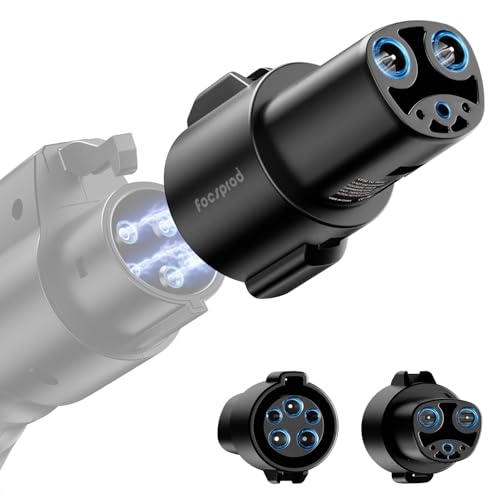
- Supports Level 1 and Level 2 AC charging
- Rated up to 80A and 250V
- UL 2252-compliant design with three-year warranty
Best For: Tesla owners using compatible J1772 AC stations
Best for CCS1 Supercharger Access
NACS-to-CCS1 Fast-Charge Adapter

- Designed for compatible Tesla Superchargers
- Supports up to 500A, 1000V, and 250kW
- For approved CCS1 EVs; not for AC charging
Best For: CCS1 EV owners with enabled Tesla Supercharger access
Best for J1772 EVs Using Tesla Chargers
FOCSPROD Tesla-to-J1772 Adapter

- Supports Tesla AC connectors and Destination Chargers
- Handles Level 2 charging up to 60A and 250V
- UL 2252-compliant with security lock and three-year support
Best For: J1772 EV drivers using compatible Tesla AC equipment
Best Overall – LENZ J1772-to-NACS 80A Adapter
For Tesla and other NACS vehicles, the LENZ is a versatile choice among ev charging adapters when you need to use J1772 Level 1 or Level 2 stations. Its compact design, 80A rating, and UL 2251 compliance make it well suited to home, workplace, hotel, and public charging.
Best For: Tesla and NACS EV owners who want broad access to J1772 AC charging.
Pros:
- Compatible with all Tesla models and listed NACS-equipped EVs.
- Supports Level 1 and Level 2 AC charging up to 80A and 250V.
- UL 2251 and CSA compliant, with an IP54 rating.
- Lightweight glove-box-sized design and a 2-year protection plan.
Cons:
- Designed for J1772 AC charging, not DC fast charging.
- Actual charging speed depends on the vehicle and charging station.
The LENZ stands out as a practical all-around adapter for expanding access to J1772 stations. Its high electrical rating and broad vehicle compatibility provide useful flexibility without adding much bulk.
Best for Dryer-Outlet Charging – CircleCord NEMA 10-30 to 14-50 Adapter
The CircleCord is a specialized option among ev charging adapters for connecting an EV charger with a NEMA 14-50 connection to a compatible 30A NEMA 10-30 dryer outlet. It is intended only for EV charging, with the manufacturer recommending a vehicle charging setting of no more than 24 amps.
Best For: Tesla owners with a suitable NEMA 10-30 outlet who need a short adapter cord for Level 2 charging.
Pros:
- Converts a NEMA 10-30P outlet connection to a NEMA 14-50R connection.
- Compatible with Tesla Model 3, S, X, and Y charging setups.
- ETL listed as a complete product.
- Uses 10-gauge wiring with a molded, flame-retardant, UV-resistant jacket.
Cons:
- Not for RV or dryer use despite using a dryer-style outlet.
- Recommended charging setting is limited to 24 amps.
- Compatibility depends on having the correct 10-30 outlet and EV charging equipment.
This cord can be useful when a home has an appropriate 10-30 outlet but should be treated as an EV-only solution. Follow the stated 24-amp recommendation and confirm the outlet and charger configuration before use.
Best Weatherproof Option – Lectron J1772-to-Tesla 80A Adapter
The Lectron provides a straightforward way for Tesla and NACS-alliance vehicles to use J1772 chargers. As ev charging adapters go, it combines an 80A, 240V AC rating with an IP67 weatherproof enclosure, making it a strong fit for outdoor charging at home or on the road.
Best For: Tesla and NACS EV drivers who prioritize weather resistance and compact plug-and-play operation.
Pros:
- Compatible with Tesla Model S, 3, X, Y, Cybertruck, and NACS-alliance EVs.
- Supports Level 1 and Level 2 AC charging up to 80A at 240V.
- IP67 weatherproof rating for outdoor use.
- Includes TUV and UL 2251 certifications and a 2-year warranty.
Cons:
- For J1772 AC charging rather than DC fast charging.
- Vehicle and station limitations may prevent charging at the full 80A rating.
The Lectron is a well-rounded pick when outdoor durability matters. Its compact plug-and-play format makes it convenient to keep in a vehicle, while its electrical rating supports a wide range of J1772 AC charging setups.
Best for DC Fast Charging – FOCSPROD NACS-to-CCS1 500A Adapter
The FOCSPROD is a DC fast-charging adapter for compatible CCS1 electric vehicles that have been enabled by their automaker to use Tesla Superchargers. Unlike many ev charging adapters intended for AC stations, this model is rated for Tesla Supercharger use, but compatibility must be confirmed before purchase.
Best For: Compatible Ford, GM, Rivian, and other CCS1 EVs seeking access to supported Tesla Supercharger locations.
Pros:
- Designed to connect CCS1 EVs to compatible Tesla Superchargers.
- Rated for up to 500A and 1,000V DC fast charging.
- Interlock construction is intended to add connection stability.
- UL 2252 compliance and a 3-year warranty are included in the supplied specifications.
Cons:
- Not compatible with Level 1 or Level 2 AC chargers.
- Automaker and network authorization is required, and compatibility varies by vehicle.
- The supplied notes list Audi, BMW, Mercedes-Benz, Kia, Mazda, MINI, Nissan, Porsche, Stellantis, Toyota, Volkswagen, and Honda as currently incompatible.
This adapter is potentially valuable for CCS1 drivers who have confirmed Tesla Supercharger support through their automaker. Because compatibility restrictions are significant, verify both the vehicle and charging-network authorization before relying on it for travel.
Heavy-Duty Welder-Outlet Adapter – NEMA 6-50P to 14-50R EV Adapter
This NEMA 6-50P to 14-50R cord is a practical option among ev charging adapters when your EV charging setup uses a 6-50 welder outlet and your charger has a 14-50 plug. Its 6 AWG copper wiring and ETL listing are useful for higher-power Level 2 charging, but it is specifically for EVs—not RVs or standard 110V outlets.
Best For: Tesla and other compatible EV owners adapting a NEMA 6-50 outlet to a 14-50 EV charger connection.
Pros:
- 6 AWG/3C copper wiring supports a heavy-duty 50A, 250V-rated design.
- Compatible with Tesla UMC Cybertruck, Model 3, Model Y, Model X, Model S, and J1772 EV charging setups.
- ETL listed and covered by an 18-month warranty, with a durable, flame-retardant sleeve.
- Opposing connector orientation makes direct connection easier without twisting.
Cons:
- Not compatible with RVs or 110V household outlets.
- The manufacturer recommends setting charging current to no more than 32A.
- Its 1-foot length may be limiting in some installations.
This is a focused adapter for converting a compatible 6-50 outlet to a 14-50 EV charger connection. Confirm your outlet, charger plug, and vehicle requirements before purchase, and follow the stated 32A charging-current guidance.
Supercharger Access Adapter – LENZ NACS to CCS1 DC Fast-Charge Adapter
The LENZ NACS to CCS1 adapter is one of the ev charging adapters designed for approved CCS1 vehicles that can access Tesla NACS Supercharger stations. It supports high-power DC fast charging and includes weather protection plus a travel case, but it is not intended for Level 1 or Level 2 charging.
Best For: Owners of Tesla-approved CCS1 EVs who need an adapter for compatible NACS Supercharger access.
Pros:
- Rated for up to 500A and 1000V DC charging, with support for charging up to 250 kW as specified.
- UL 2252 compliant and SGS tested/listed.
- IP67 weatherproof construction and secure-locking connectors support outdoor use.
- Includes a protective travel case and LENZ customer support.
Cons:
- Works only with CCS1 EVs that Tesla has approved for Supercharger access.
- Not compatible with Level 1 or Level 2 chargers.
- Compatibility must be verified through the vehicle manufacturer or EV app.
This adapter can broaden fast-charging access for the right CCS1 vehicle, but approval is the key buying consideration. Verify both your vehicle’s Supercharger eligibility and the station’s charging requirements before ordering.
Cross-Standard Charging Adapter – CCS1 to CCS2 AC/DC EV Adapter
This CCS1 to CCS2 adapter is aimed at drivers using Europe-specification EVs with compatible charging equipment in the United States. Among ev charging adapters, it stands out for supporting both AC and DC connections, with temperature monitoring and a protective case, though vehicle and protocol compatibility should be confirmed carefully.
Best For: Compatible European EVs needing to connect to CCS1 or J1772 charging equipment in the U.S.
Pros:
- Supports AC charging up to 32A and DC charging up to 400A.
- Handles up to 250V AC and 1000V DC according to the supplied specifications.
- Temperature protection pauses charging above 85°C and can resume below 65°C after the vehicle accepts the signal.
- Includes silver-plated guide pins and a portable impact-resistant storage case.
Cons:
- Compatibility depends on the vehicle’s charging protocols and connector requirements.
- Some vehicles may require unplugging and reinserting the adapter after temperature protection activates.
- The charging device must be connected to the specified end for proper operation.
This adapter offers useful AC and DC flexibility for compatible cross-standard setups. Because charging behavior can vary by vehicle, confirm protocol support and follow the connection instructions before relying on it for regular charging.
Best Overall for Tesla AC Charging – FOCSPROD J1772-to-Tesla Adapter
If you need more flexibility from public or workplace AC stations, this J1772-to-Tesla adapter expands your options without adding much bulk. It supports Level 1 and Level 2 charging and is rated for up to 80A at 110V–250V.
Best For: Tesla owners who want to use compatible J1772 charging stations at home, work, or on the road.
Pros:
- Compatible with Tesla Model 3, Y, X, S, and Cybertruck vehicles, with the listing noting Model 3 vehicles made after 2020.
- Supports Level 1 and Level 2 charging, rated up to 80A and 250V.
- SGS certified to comply with UL 2252, with a polycarbonate enclosure and silver-plated pins.
- Compact design and a three-year limited warranty.
Cons:
- Requires a clean charging port for reliable connection.
- Compatibility details should be checked for the specific Tesla model and vehicle year.
This is a practical choice among ev charging adapters when you want broad AC charging compatibility and a high stated current rating. It is designed for AC charging rather than DC fast-charging use.
Best for CCS1 Supercharger Access – NACS-to-CCS1 Fast-Charge Adapter
This NACS-to-CCS1 adapter is aimed at CCS1 electric vehicles that have been approved for Tesla Supercharger access. It is designed for DC fast charging and lists support up to 500A, 1000V, and 250kW, but fitment and network authorization must be confirmed before purchase.
Best For: CCS1 EV drivers whose vehicle manufacturer has enabled access to compatible Tesla Superchargers.
Pros:
- Designed to connect CCS1 electric vehicles to compatible Tesla Superchargers.
- Lists high-power DC charging support up to 500A, 1000V, and 250kW.
- Provides access to compatible Tesla Supercharging locations, including listed V3 and V4 stations.
- Portable design connects between the vehicle charging port and the Supercharger.
Cons:
- Not compatible with Level 1 or Level 2 AC chargers.
- Vehicle compatibility and Tesla Supercharger protocol access must be verified with the manufacturer.
- The listing specifies a one-year warranty.
Among ev charging adapters, this model is the specialized option for DC fast charging on the Tesla network. Its usefulness depends heavily on vehicle approval and charging-network authorization, so those checks should come before ordering.
Best for J1772 EVs Using Tesla Chargers – FOCSPROD Tesla-to-J1772 Adapter
J1772 EV drivers can use this Tesla-to-J1772 adapter to connect with compatible Tesla Mobile Connectors, Wall Connectors, and Destination Chargers. It supports Level 2 AC charging up to 60A at 250V and is intended for convenient charging at home or on the road.
Best For: J1772 electric vehicles that need access to compatible Tesla AC charging equipment.
Pros:
- Works with Tesla Mobile Connectors, High Powered Wall Connectors, and Destination Chargers.
- Supports Level 2 AC charging up to 60A and 250V.
- SGS certified to comply with UL 2252 and includes a security lock feature.
- Compact, lightweight design with three-year customer support.
Cons:
- Not compatible with Tesla Superchargers or DC fast charging.
- Compatibility is limited to suitable Tesla AC charging equipment and J1772 EVs.
This adapter is a straightforward option for expanding AC charging access without carrying a large accessory. Choose it when your priority is Tesla destination or connector-based charging, not Supercharger use.
How We Picked These Ev Charging Adapters
We focused on adapters that solve common compatibility problems without obscuring important electrical limits. The selection includes AC adapters for home and destination charging, outlet adapters for NEMA 10-30 and 6-50 connections, and DC fast-charging adapters for NACS-to-CCS1 use. We compared stated amperage and voltage ratings, connector standards, weather-resistance claims, locking or interlock features, cable construction, and the vehicle types each adapter is designed to support.
Ratings are not interchangeable: an adapter’s maximum capacity does not increase the limits of the vehicle, charging station, circuit, or cable. Always verify the manufacturer’s specifications before use.
Quick Comparison
| Adapter type | Best suited for | Typical use |
|---|---|---|
| J1772 to NACS | Tesla and NACS vehicles | Using J1772 Level 1 or Level 2 stations |
| NACS to CCS1 | CCS1 vehicles | Accessing compatible Tesla Superchargers |
| NEMA 10-30 to 14-50 | Homes with dryer outlets | Connecting a compatible Level 2 charger |
| NEMA 6-50 to 14-50 | Homes with welder outlets | Using a 14-50 EV charger on a 6-50 receptacle |
| CCS1 to CCS2 | Cross-standard charging | Connecting Type 1 and Type 2 systems where supported |
Key Buying Factors for Ev Charging Adapters
Connector and Vehicle Compatibility
Identify both ends of the connection before buying. J1772, NACS, CCS1, and CCS2 are different standards, and an adapter intended for AC charging cannot substitute for a DC fast-charging adapter. Confirm compatibility with your exact vehicle model, charging network, and inlet configuration.
Electrical Ratings and Circuit Capacity
Check voltage, amperage, and whether the product supports AC or DC. A listed 80A or 500A rating is only a maximum; the actual charging rate is governed by the vehicle, charger, station, and circuit. For outlet adapters, ensure the receptacle, breaker, wiring, and continuous-load rating are appropriate. Have a qualified electrician inspect unfamiliar or older wiring.
Safety, Fit, and Environment
Look for clear certification or testing claims, secure locking features, heat-resistant construction, and an IP rating when outdoor use is expected. The connectors should seat fully without excessive force or looseness. Do not use an adapter with damaged contacts, overheating, water intrusion, or a modified outlet.
Who Should Buy Which Ev Charging Adapters?
Tesla or NACS Drivers Using Public AC Stations
Choose a well-rated J1772-to-NACS adapter. An 80A-rated model offers broad capacity, but it still operates within the limits of the station and vehicle.
CCS1 EV Owners Seeking Tesla Fast Charging
Choose a NACS-to-CCS1 DC adapter specifically approved for the vehicle and charging network. Confirm Supercharger access and software eligibility before relying on it for road trips.
Drivers Charging from a Dryer or Welder Outlet
Select the outlet adapter matching the exact NEMA configuration. These products are useful only when the circuit is suitable for continuous EV charging; avoid sharing a circuit with high-draw appliances.
Owners Needing Cross-Region Compatibility
A CCS1-to-CCS2 adapter may help in supported charging environments, but regional standards and station authorization vary. Verify both AC and DC compatibility rather than assuming the connector shape guarantees operation.