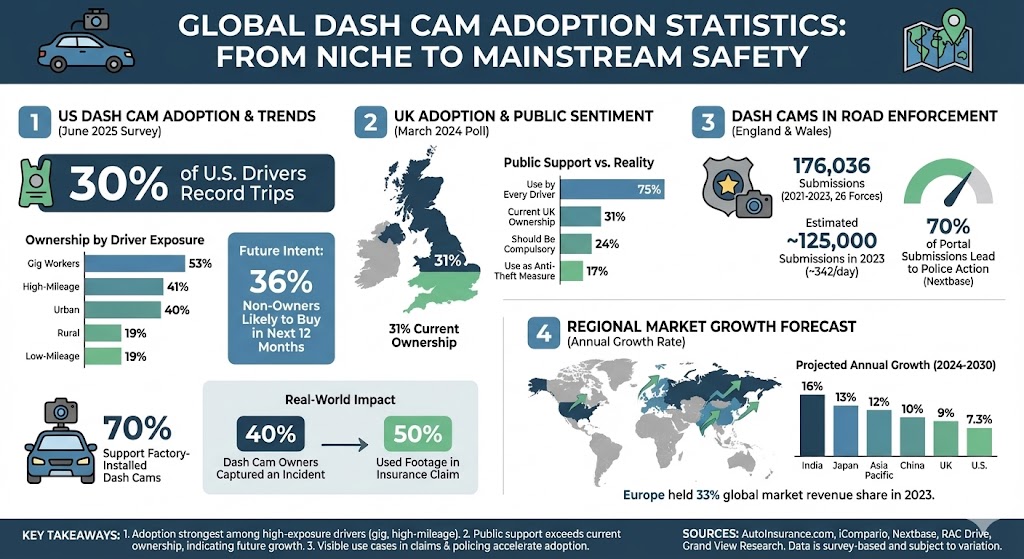
Dash cam adoption is moving from a niche accessory trend into a mainstream safety and evidence story. The latest survey and market data show stronger uptake among high-exposure drivers, broad support for factory-fitted cameras, and faster growth in countries where dash cam footage is increasingly useful for claims, policing, and fleet oversight.
dash cam adoption statistics
Key dash cam adoption statistics
30% of U.S. drivers said they already record trips with dash cams in a June 2025 survey.
Urban drivers in that survey were more than twice as likely to own a dash cam as rural drivers: 40% versus 19%.
53% of gig workers and 41% of high-mileage drivers reported owning a dash cam.
36% of U.S. drivers without a dash cam said they were likely to buy one within the next 12 months.
40% of dash cam owners said they had already captured a crash or traffic incident.
Half of owners who captured an incident said they used the footage in an insurance claim.
70% of U.S. drivers said dash cams should be factory-installed in all new vehicles.
In the UK, 31% of motorists said they currently own a dash cam in a March 2024 poll.
Three in four UK respondents said dash cams should be used by every driver, while 24% said they should be compulsory.
An FOI-based analysis covering 26 police forces found 176,036 dash cam submissions in England and Wales between 2021 and 2023.
Nextbase says 70% of submissions to the National Dash Cam Police Portal have led to further police action.
Europe held 33% of global dashboard camera market revenue in 2023.
Grand View Research expects India’s dash cam market to grow at 16% annually from 2024 to 2030, ahead of Japan at 13% and China at 10%.
Note: consumer ownership figures are survey-based, so percentages can vary by country, sample, and question wording.
Dash cam ownership is strongest among higher-exposure drivers
The clearest adoption pattern is that the more time, risk, or commercial exposure a driver has on the road, the more likely they are to install a dash cam. Gig workers lead the pack, while rural and low-mileage drivers remain well below the national adoption leaders.
Adoption is already meaningful, but demand still appears to be rising. A large share of non-owners say they plan to buy a dash cam, while support for factory-installed devices is much higher than current ownership. That gap usually signals a category with more room to grow.
Label
Bar
Value
Own dash cam
30%
Likely to buy next year
36%
Captured an incident
40%
Want factory-installed dash cams
70%
Max = 70. Widths: Own dash cam 42.86%, Likely to buy next year 51.43%, Captured an incident 57.14%, Want factory-installed dash cams 100.00%
UK ownership still trails public support
UK survey data shows a familiar adoption pattern: ownership is already substantial, but it still sits well below overall public support. That helps explain why dash cam use keeps expanding as more drivers see the devices as a normal part of documenting incidents and protecting themselves on the road.
Label
Bar
Value
Use by every driver
75%
Current UK ownership
31%
Should be compulsory
24%
Use as anti-theft measure
17%
Max = 75. Widths: Use by every driver 100.00%, Current UK ownership 41.33%, Should be compulsory 32.00%, Use as anti-theft measure 22.67%
Dash cam footage is becoming part of the road enforcement system
Adoption tends to accelerate when drivers can see a practical payoff. In England and Wales, public dash cam submissions have become a meaningful source of video evidence, and the high rate of follow-up police action helps reinforce the idea that these devices are not just passive gadgets.
176,036 dash cam submissions were counted across 26 police forces in England and Wales between 2021 and 2023.
That same FOI-based analysis estimated roughly 125,000 submissions in 2023 alone, or about 342 per day.
Nextbase says 70% of National Dash Cam Police Portal submissions have led to further police action.
Regional market growth points to continued adoption
Consumer ownership surveys tell one side of the story, while market forecasts show where adoption is likely to deepen next. Europe already accounts for the biggest revenue share, but Asia Pacific is forecast to grow faster, especially in India and Japan.
Label
Bar
Value
India
16%
Japan
13%
Asia Pacific
12%
China
10%
UK
9%
U.S.
7.3%
Max = 16. Widths: India 100.00%, Japan 81.25%, Asia Pacific 75.00%, China 62.50%, UK 56.25%, U.S. 45.63%
What these dash cam adoption numbers mean
Three patterns stand out. First, dash cams are already mainstream for the drivers who face the most road exposure, such as gig workers and high-mileage motorists. Second, public support still runs ahead of actual ownership, which usually points to more upside in future adoption. Third, adoption gets stronger when the device has a visible use case, whether that is settling incidents, supporting police action, or feeding into fleet and insurance workflows.
Sources
AutoInsurance.com, Dash Cam Use Rising: 30% of U.S. Drivers Now Record Trips — https://www.autoinsurance.com/research/dash-cam-usage-report/
iCompario, Dash Cam Submissions to Police Rise with Operation Snap — https://www.icompario.com/en-gb/guides/dash-cam-police-submission-statistics/
Nextbase, Road Safety Club — https://nextbase.co.uk/road-safety-club/
RAC Drive, Just 6.7% of car thefts result in a conviction — https://www.rac.co.uk/drive/news/motoring-news/shocking-report-reveals-just-6-of-car-thefts-result-in-a-conviction/
Grand View Research, Dashboard Camera Market Size, Share, Growth Report 2030 — https://www.grandviewresearch.com/industry-analysis/dashboard-camera-market