The best engine stands for professional workshops make rebuilding, inspection, and servicing easier by providing stable support and controlled access to the engine block. Capacity, rotation, locking positions, and mobility all matter when equipment will see frequent use.
We compare 10 rotating and foldable models across several weight classes, focusing on workshop practicality, frame strength, mounting flexibility, and ease of movement.
Best 10 Engine Stands for Professional Workshops Picks for 2026
Best Heavy-Duty Pick
BIG RED T26801 Rotating Engine Stand

- 1,500-pound capacity
- 360-degree rotating head
- Folding, five-caster frame
Best For: Professional workshops handling heavier engine blocks
Best Storage-Friendly Pick

- 1,250-pound capacity
- 360-degree adjustable head
- Disassembles for storage
Best For: Workshops needing convenient transport and storage
Best Value Mobility Pick
VEVOR 750 lb. Rotating Engine Stand

- 750-pound capacity
- Stable H-shaped base
- Four casters with one brake
Best For: Shops servicing lighter engines with frequent repositioning
Best Workshop Convenience Pick
Jackco 1000 lb. Rotating Engine Stand

- 1,000-pound capacity
- Self-locking 360-degree rotation
- Built-in tool tray
Best For: Professional mechanics who value organization and secure positioning
Workshop-Proven Choice
OTC 1726A 1,000 lb Engine Stand
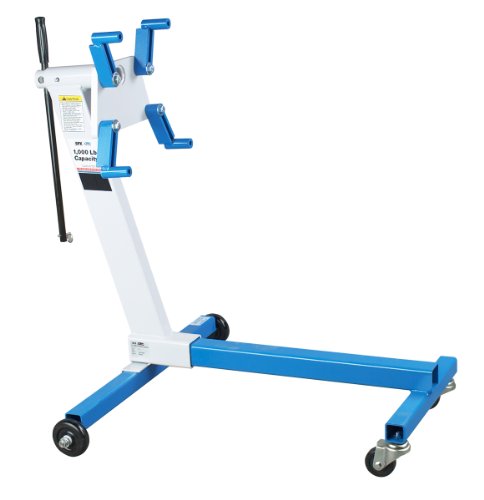
- 1,000 lb capacity for passenger cars and light trucks
- 360° rotation with 8 locking positions
- Four adjustable arms and locking rear wheels
Best For: Passenger car and light truck engine rebuilding
Heavy-Duty Space Saver

- Supports engines up to 2,000 lb
- 360° swivel head with four adjustable arms
- Foldable base and six casters for storage and movement
Best For: Mixed engine work where capacity and storage flexibility matter
Controlled Rotation Specialist
JEGS 1500 lb Geared Engine Stand
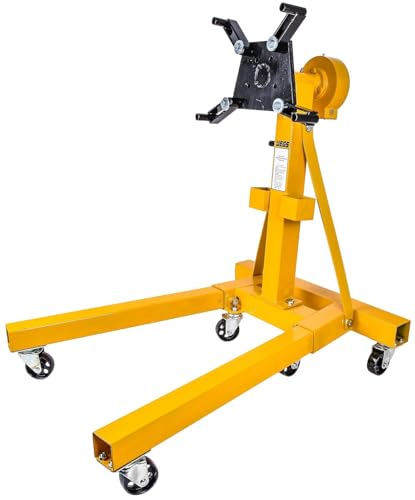
- 1,500 lb capacity for automotive applications
- Adjustable 360° geared mounting head
- Square-tube frame and ball-bearing casters
Best For: Automotive workshops prioritizing geared rotation and mobility
Workshop Stability Pick
BIG RED 1,500-Lb Foldable Engine Stand
- 1,500-pound alloy-steel capacity
- Wide base, five casters, and rotating head
- Foldable frame for compact storage
Best For: Professional garages needing a stable, versatile stand
Secure Mobility Choice
VEVOR 1,500-Lb Rotating Engine Stand

- 1,500-pound tested load capacity
- Five casters with four brakes
- Folds to 14.8 inches wide
Best For: Workshops needing controlled movement and compact storage
Maximum Capacity Option
LOCKIETTA 2,000-Lb Foldable Engine Stand
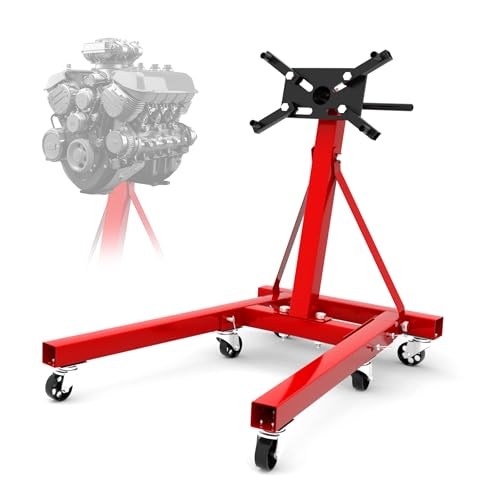
- 2,000-pound heavy-duty capacity
- Six universal casters and rotating head
- Adjustable arms with foldable H-shaped base
Best For: Shops handling heavier engines and demanding repairs
Best Heavy-Duty Pick – BIG RED T26801 Rotating Engine Stand
For professional workshops that need substantial capacity and convenient engine access, the BIG RED T26801 combines a 1,500-pound rating with a 360-degree rotating mounting head. Its wide base, multiple casters, and folding frame make it a practical choice for demanding repair work and storage-conscious shops.
Best For: Professional workshops handling heavier foreign and domestic engine blocks.
Pros:
- High 1,500-pound load capacity for demanding applications.
- Four adjustable arms and 360-degree rotation provide access around the engine.
- Extra-wide base and five casters support stability and maneuverability.
- Folding frame and powder-coated finish aid storage and rust resistance.
Cons:
- At 76.7 pounds, it is relatively heavy to move or reposition.
- Its larger capacity may be more than needed for lighter engine projects.
The BIG RED stands out when capacity and stability matter most. The folding design adds useful flexibility, while the rotating head helps reduce the need to work around a fixed engine position.
Best Storage-Friendly Pick – JEGS 1,250 lb. Engine Stand
The JEGS engine stand is a sensible option for professional workshops seeking a balance of capacity, rotation, and easy storage. Its heavy-gauge square steel frame disassembles for transport, while the adjustable mounting head supports access during engine assembly and disassembly.
Best For: Workshops that frequently transport or store their engine stand.
Pros:
- 1,250-pound capacity suits many engine service tasks.
- 360-degree adjustable head supports work on both low and top-end components.
- Heavy-gauge square steel construction provides a sturdy frame.
- Disassembly design simplifies storage and transport.
Cons:
- It does not list a built-in tool tray or brake-equipped caster in the supplied details.
- At 63.4 pounds, it still requires some effort to move when assembled.
Choose this JEGS model when compact storage and portability are priorities. Its capacity remains substantial, and the rotating head gives technicians flexibility without committing to a permanently assembled stand.
Best Value Mobility Pick – VEVOR 750 lb. Rotating Engine Stand
For professional workshops servicing lighter engines, the VEVOR rotating engine stand offers a 750-pound capacity with a stability-focused H-shaped base. Four adjustable arms, a 360-degree head, and a lockable caster make it adaptable for routine vehicle maintenance and repair work.
Best For: Shops working on engines up to 750 pounds that value mobility and adjustable positioning.
Pros:
- H-shaped base is designed to reduce shaking and tilting.
- Four adjustable arms and 360-degree rotation support varied engine configurations.
- Two fixed and two universal casters provide mobility, with one brake-equipped caster.
- Electrostatic coating helps protect against rust.
Cons:
- Its 750-pound capacity is lower than the other stands in this roundup.
- The four-caster layout may offer less load capacity than heavier-duty designs.
The VEVOR is a practical fit when a shop needs maneuverability without a high-capacity stand. Its extended handle, six location holes, and lockable caster add useful control during positioning and maintenance.
Best Workshop Convenience Pick – Jackco 1000 lb. Rotating Engine Stand
The Jackco 71000R is built for professional workshops that want a sturdy rotating stand with integrated organization. Its 1,000-pound capacity, self-locking 360-degree rotation, adjustable mounting arms, and tool tray support efficient engine repair and maintenance.
Best For: Professional mechanics who want built-in tool storage and secure positioning.
Pros:
- 1,000-pound capacity supports a broad range of engine work.
- Self-locking rotation secures the engine at the working angle.
- Adjustable arms accommodate different engine sizes and configurations.
- Integrated tool tray keeps tools and parts within reach.
Cons:
- At 95 pounds, it is the heaviest stand in this selection.
- The supplied notes do not specify a folding or disassembly feature for storage.
The Jackco earns consideration for its workshop-oriented design. The tool tray reduces trips for frequently used items, while the self-locking rotation and locking swivel casters support controlled, organized work.
Workshop-Proven Choice – OTC 1726A 1,000 lb Engine Stand
For professional workshops handling passenger-car and light-truck rebuilds, the OTC 1726A focuses on controlled positioning and straightforward engine mounting. Its 1,000-pound capacity, full rotation, and locking system make it a practical option for regular repair work.
Best For: Passenger car and light truck engine rebuilding or repair in professional workshops.
Pros:
- Four adjustable attachment arms help simplify engine mounting.
- 360-degree rotation and eight locking positions support access from multiple angles.
- Two locking rear wheels help anchor the stand during work.
- One-bolt disassembly makes transport easier.
Cons:
- Its 1,000-pound capacity is lower than the heavier-duty stands in this roundup.
- At 102 pounds and 46 inches long, it may require dedicated storage space.
The OTC 1726A is a well-targeted choice when workshop jobs center on compatible car and light-truck engines and stable, repeatable positioning matters more than maximum capacity.
Heavy-Duty Space Saver – 2000 lb Foldable Engine Stand
Professional workshops needing high capacity and flexible storage may find this 2,000-pound foldable stand especially useful. It combines a 360-degree swivel head, adjustable mounting arms, and six casters for moving engines around the shop.
Best For: Workshops that handle varied engine sizes and need compact post-job storage.
Pros:
- Heavy-duty steel construction supports engines up to 2,000 pounds.
- 360-degree swivel head helps position the engine for assembly, cleaning, and repair.
- Four adjustable arms accommodate different engine sizes and bolt patterns.
- Foldable H-base and six casters support storage and shop mobility.
Cons:
- The supplied notes do not specify the stand’s assembled weight or dimensions.
- Its broad compatibility may be more than necessary for shops working with one engine type.
With the highest stated capacity here and a fold-flat base, this model is a versatile choice for professional workshops balancing demanding loads with limited floor space.
Controlled Rotation Specialist – JEGS 1500 lb Geared Engine Stand
For professional workshops seeking a geared rotating design, the JEGS 1500 lb engine stand offers an adjustable 360-degree mounting head and a square-tube frame. Its ball-bearing casters and easy assembly or disassembly add practical handling benefits.
Best For: Automotive workshops wanting geared rotation and a 1,500-pound capacity.
Pros:
- 1,500-pound capacity suits a range of automotive applications.
- Geared rotating head provides adjustable 360-degree positioning.
- Square-tube frame is designed for dependable workshop use.
- Ball-bearing casters support movement around the shop.
Cons:
- Its capacity is below the 2,000-pound option in this roundup.
- The supplied notes do not list the number of mounting arms or locking positions.
The JEGS stand is a balanced middle-capacity option for shops that prioritize geared rotation, mobility, and a frame designed for repeated automotive applications.
Workshop Stability Pick – BIG RED 1,500-Lb Foldable Engine Stand
For professional workshops seeking engine stands for professional workshops, the BIG RED combines a 1,500-pound capacity with a wide base, four adjustable mounting arms, and a 360-degree rotating head. Its five-caster design supports controlled movement, while the folding frame helps simplify storage.
Best For: Professional garages and repair shops that need a stable, movable stand for most car, truck, and SUV engines.
Pros:
- Supports engines up to 1,500 pounds.
- Extra-wide base and five casters provide stability and maneuverability.
- Four adjustable arms and 360-degree rotation improve access during repairs.
- Folding mechanism saves storage space.
Cons:
- At 84.7 pounds, it is relatively heavy to move without rolling.
- The notes do not specify individual caster brake functionality.
Choose this model when stability and broad vehicle compatibility matter more than minimizing stand weight. Its foldable frame and rotating mounting head make it a practical all-around option for busy workshops.
Secure Mobility Choice – VEVOR 1,500-Lb Rotating Engine Stand
The VEVOR is a practical choice among engine stands for professional workshops, pairing a 1,500-pound tested capacity with an H-shaped base and a 360-degree rotating mount. Its five universal casters include four brakes, helping technicians position and secure the stand during engine work.
Best For: Auto workshops that prioritize secure positioning, smooth movement, and compact storage.
Pros:
- Tested to support loads up to 1,500 pounds.
- H-shaped base helps reduce shaking and tilting.
- Five 360-degree casters include four brakes for positioning control.
- Folds to a 14.8-inch width for easier storage.
Cons:
- Its listed 62.2-pound weight may indicate a lighter build than some heavier-duty stands.
- The notes do not identify specific vehicle compatibility beyond workshop engine repair use.
With locking casters and a narrow folded profile, this VEVOR model is especially suited to shops that frequently reposition equipment or have limited floor space. The adjustable arms and rotating head support access around the engine.
Maximum Capacity Option – LOCKIETTA 2,000-Lb Foldable Engine Stand
For heavier powertrains, the LOCKIETTA stands out among engine stands for professional workshops with a 2,000-pound capacity, high-strength steel frame, and six universal wheels. Its rotating head and adjustable arms are designed to support access during assembly, disassembly, and maintenance.
Best For: Professional and DIY automotive repair work involving heavier engines and varied engine configurations.
Pros:
- 2,000-pound capacity provides the highest rated load in this selection.
- 360-degree rotating head improves access around the engine.
- Four adjustable arms accommodate different engine sizes and configurations.
- Six universal casters support workshop mobility, and the frame folds for storage.
Cons:
- At 100 pounds, it is the heaviest option in this group.
- The notes do not specify caster brakes.
- Its 47-inch listed height may require more vertical storage space.
The LOCKIETTA is the logical pick when load capacity is the primary concern. Its heavier construction and six-wheel layout favor demanding repair environments, though buyers should account for its greater weight and overall size.
How We Picked the Best Engine Stands for Professional Workshops
We evaluated these engine stands by the features that matter most in a busy repair environment: rated load capacity, frame construction, rotating-head design, mounting-arm adjustability, wheel configuration, storage practicality, and access to useful features such as locking positions or tool trays. We also considered whether a stand is suited to occasional passenger-car work or repeated professional use.
A published weight rating is only a starting point. The engine, accessories, adapters, and mounting hardware must remain within the manufacturer’s limit, and the stand should be assembled and used on a level surface according to its instructions.
Quick Comparison
| Capacity range | Best suited to | Typical advantages |
|---|---|---|
| 750–1,000 lb | Passenger cars and lighter engines | Easier maneuvering and lower cost |
| 1,250–1,500 lb | General workshop rebuilding | Strong balance of capacity and versatility |
| 2,000 lb | Large or heavier powertrains | Higher load margin and robust support |
Key Buying Factors for Engine Stands for Professional Workshops
Capacity and Safety Margin
Choose a stand with substantially more capacity than the bare engine weight. A higher rating can improve stability when the engine is partially disassembled, fitted with accessories, or positioned off-center, but it does not replace proper balancing and secure mounting.
Rotation and Locking Control
A 360-degree rotating head improves access during cleaning and rebuilding. Look for positive locking positions or a geared mechanism if technicians need precise positioning and repeatable control. Confirm that the mounting arms and included hardware match the engine’s block pattern.
Mobility and Footprint
Four or five casters can make a stand easier to reposition, while six-wheel designs may offer additional support for heavier loads. Check caster quality, wheel clearance, turning space, and whether the folded footprint suits your storage area. A foldable frame is useful when the stand is not permanently assigned to a bay.
Workshop Durability
Heavy-gauge steel, well-supported joints, stable legs, and a reliable locking system are more important than cosmetic features. Tool trays can improve efficiency, but they should not be used to carry loads beyond their stated limits or to create an unstable center of gravity.
Who Should Buy Which Engine Stands for Professional Workshops?
Choose a 750- or 1,000-pound model for lighter passenger-car engines, occasional rebuilds, and shops prioritizing easier movement. A 1,250- to 1,500-pound stand is the most versatile choice for general professional work, offering useful capacity without the largest footprint. Select a 2,000-pound foldable stand when heavier engines, larger assemblies, or greater capacity headroom are routine requirements.
Before ordering, verify the engine’s mounting-bolt pattern, the stand’s overall dimensions, caster clearance, rotation range, and warranty or replacement-parts support. For commercial shops, a stable stand with a clear safety margin and durable locking hardware is usually a better long-term investment than the cheapest available option.