The right bottle jack can make vehicle servicing faster, more controlled, and easier on your team. For professional workshops, capacity is only part of the decision: lifting range, stability, construction, portability, and operating speed also matter.
We compared 10 hydraulic and air-hydraulic models ranging from compact 6-ton options to heavy-duty 20-ton jacks. Use the guide below to match the jack’s design and capacity with your vehicles, workflow, and shop conditions.
Best 10 Bottle Jacks for Professional Workshops Picks for 2026
Heavy-Duty Shop Standard
BIG RED T91003B 10-Ton Bottle Jack
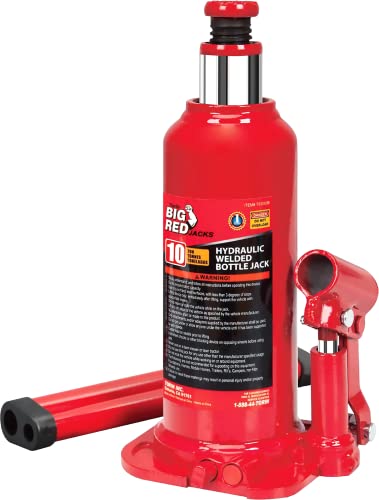
- 20,000-pound lifting capacity
- 8-13/16- to 17-5/8-inch height range
- Welded steel body with overload protection
Best For: Commercial and residential vehicle workshops
Maximum Capacity Workhorse
Pro-Lift B-S20D 20-Ton Bottle Jack

- 20-ton lifting capacity
- Heat-treated stress areas for durability
- Carrying handle and bypass protection
Best For: Heavy-duty shop, farm, and automotive lifting
Portable Garage Specialist
DNA Motoring 6-Ton Bottle Jack

- 12,000-pound capacity
- 8.6- to 17.1-inch lifting range
- Detachable handle and storage case
Best For: Portable automotive work on cars, SUVs, and pickups
Long-Stroke Specialist

- 8-ton capacity for equipment work
- Long-stroke design for industrial applications
- Ductile iron base and ram bypass system
Best For: Manufacturing, farm, trailer, and engine-equipment applications
Best Pneumatic Option
VEVOR 20-Ton Air Hydraulic Bottle Jack

- 20-ton capacity for trucks, RVs, and equipment
- Pneumatic or manual operation
- 10.4- to 19.7-inch lifting range
Best For: Air-equipped professional workshops needing fast, flexible lifting
Best Traditional Shop Jack
Torin 20-Ton Welded Bottle Jack
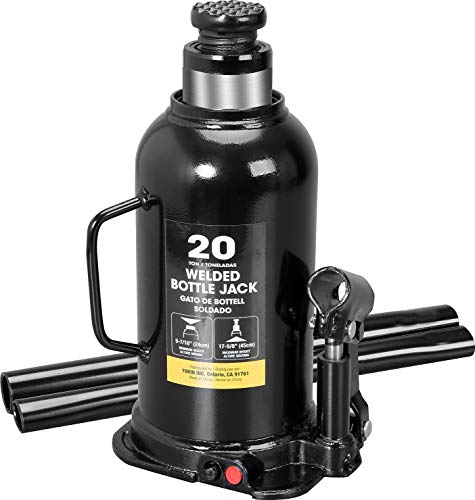
- 40,000-pound lifting capacity
- Serrated saddle for secure load contact
- Welded alloy-steel body with overload protection
Best For: Workshops wanting a conventional, high-capacity manual jack
Best Portable High-Profile Jack
VEVOR 20-Ton Hydraulic Bottle Jack

- 20-ton capacity without air or electricity
- Three-section handle for manual lifting
- Compact 16.1-pound portable design
Best For: Mobile technicians and shops needing compressor-free lifting
Heavy-Duty Low-Profile Pick
20-Ton Torin Stubby Bottle Jack

- 20-ton capacity for demanding lifts
- Low 6-5/8-inch minimum height
- Steel construction with overload protection
Best For: Heavy vehicles and low-clearance workshop lifting
Extended-Range Workshop Pick
10-Ton Torin Welded Bottle Jack
- Lifts up to 17-5/8 inches
- Supports loads up to 20,000 pounds
- Light 10.4-pound alloy steel design
Best For: Car repair requiring extra lifting height
Balanced Capacity Pick
12-Ton Torin Welded Bottle Jack

- 12-ton capacity for mixed vehicle work
- 18-inch maximum lifting height
- Rated for cars, SUVs, and trucks
Best For: Workshops servicing varied vehicles
Heavy-Duty Shop Standard – BIG RED T91003B 10-Ton Bottle Jack
BIG RED T91003B Torin Hydraulic Welded Bottle Jack, 10 Ton (20,000 lb) Capacity, Red
Check Price On AmazonFor professional workshops that need substantial lifting capacity, the BIG RED T91003B is a practical choice among bottle jacks for professional workshops. Its 10-ton rating, adjustable screw extension, and welded alloy-steel construction suit demanding vehicle and general lifting work.
Best For: Commercial and residential shops servicing cars, SUVs, and trucks that need a broad 8-13/16- to 17-5/8-inch lifting range.
Pros:
- Supports loads up to 20,000 pounds.
- Heat-treated, serrated saddle provides a secure grip and generous lifting area.
- Welded inner and outer structure is designed for leak-free performance.
- Built-in bypass and overload valves help protect the hydraulic system.
Cons:
- Its 10.4-pound weight may be less convenient for frequent repositioning than smaller jacks.
- The supplied notes list a one-year limited warranty.
With strong capacity, a useful height range, and safety-focused hydraulic protection, this BIG RED model is a well-rounded workshop jack for heavier automotive tasks.
Maximum Capacity Workhorse – Pro-Lift B-S20D 20-Ton Bottle Jack
The Pro-Lift B-S20D stands out for its 20-ton capacity, making it one of the more powerful bottle jacks for professional workshops. Its steel saddle, adjustable extension screw, and integrated carrying handle support heavy-duty shop, farm, truck, and automotive applications.
Best For: Workshops and service areas that prioritize maximum rated capacity and need a portable jack for heavy lifting operations.
Pros:
- 20-ton capacity provides substantial lifting capability.
- Heat-treated critical stress areas are designed for durability.
- Built-in bypass system helps prevent ram overtravel.
- Integrated handle makes transport around the workspace easier.
Cons:
- The listed maximum lifting height is 11 inches, limiting reach compared with taller models.
- The supplied vehicle compatibility details specifically identify cars.
This Pro-Lift is best when capacity takes priority over extended lift height, offering heavy-load capability with useful portability and a two-year limited warranty.
Portable Garage Specialist – DNA Motoring 6-Ton Bottle Jack
For mechanics who value portability and straightforward handling, the DNA Motoring 6-ton jack is a versatile option among bottle jacks for professional workshops. It combines an anti-corrosion-treated steel body, a wide base, detachable handle, and carrying storage case.
Best For: Professional mechanics and personal garage workshops lifting cars, SUVs, and pickup trucks within an 8.6- to 17.1-inch height range.
Pros:
- 12,000-pound capacity supports a range of automotive lifting tasks.
- Wide, thick base and anti-slip top structure promote stability.
- Detachable handle and carrying case improve portability and storage.
- Anti-corrosion surface treatment helps protect the steel construction.
Cons:
- Its six-ton capacity is lower than the 10- and 20-ton alternatives in this roundup.
- The supplied notes do not specify a manufacturer warranty.
This model is a practical fit when a workshop needs a moderate-capacity jack that is easy to carry and offers generous lift height, but users should verify vehicle weight and required clearance before buying.
Long-Stroke Specialist – SUNEX 5081B 8-Ton Bottle Jack
The SUNEX 5081B is designed for applications where a long hydraulic stroke matters more than compact automotive versatility. Among bottle jacks for professional workshops, it is particularly suited to manufacturing, engine-crane, equipment-handling, and farm work.
Best For: Industrial and farm applications requiring an 8-ton jack with a long-stroke design and equipment-oriented use case.
Pros:
- Long-stroke design supports manufacturing and equipment-handling applications.
- Ductile iron base is designed for added strength.
- Larger ram diameter helps withstand side loads.
- Hydraulic bypass system prevents ram overextension.
Cons:
- The supplied specifications list a minimum height of 24.4 inches, so it is not a typical low-clearance vehicle jack.
- Its listed compatibility is for trailers rather than a broad range of passenger vehicles.
- The supplied notes give a one-year warranty.
This SUNEX is a specialized workshop tool rather than an everyday car jack. Its long-stroke construction and reinforced base make it more appropriate for industrial, farm, and equipment-handling duties.
Best Pneumatic Option – VEVOR 20-Ton Air Hydraulic Bottle Jack
For professional workshops that regularly handle trucks, RVs, pickups, and SUVs, this VEVOR air hydraulic bottle jack combines 20-ton capacity with pneumatic or manual operation. Its broad 10.4- to 19.7-inch lifting range also gives technicians useful height flexibility for inspections and repairs.
Best For: Workshops with an air compressor that want fast pneumatic lifting plus a manual backup.
Pros:
- 20-ton, or 44,092-pound, capacity suits heavy vehicles and equipment.
- Pneumatic operation enables quick, low-effort lifting, while manual pumping works without air.
- Wide lifting range and screw extension help with varied clearance requirements.
- Overload protection, dual return springs, and a leak-resistant oil port support repeated shop use.
Cons:
- Its 10.4-inch minimum height may not fit lower-clearance vehicles.
- Requires a suitable air connection to use the pneumatic function.
Choose this model when speed and versatility matter more than the simplest setup. The combination of air assistance and manual backup makes it particularly practical for busy professional workshops and field service work.
Best Traditional Shop Jack – Torin 20-Ton Welded Bottle Jack
Torin 20 Ton (40,000 LBs) Capacity Hydraulic Welded Heavy Duty Bottle Jack, AT92003BB , Black
Check Price On AmazonThe Torin AT92003BB is a straightforward hydraulic bottle jack for professional workshops that need substantial capacity without pneumatic equipment. Its 20-ton rating, welded alloy-steel construction, and adjustable screw top make it suited to cars, trucks, SUVs, and other heavy-duty applications.
Best For: Commercial or residential workshops seeking a conventional, high-capacity hydraulic bottle jack.
Pros:
- 20-ton, or 40,000-pound, capacity supports cars, trucks, and SUVs.
- Heat-treated serrated saddle provides a broad, secure contact surface.
- Welded inner and outer structure is designed for leak-free, durable operation.
- Built-in oil-bypass and overload valve helps protect the hydraulic system.
Cons:
- Its 9-7/16- to 17-5/8-inch range offers less maximum height than some alternatives.
- Manual hydraulic pumping is slower and more effort-intensive than pneumatic lifting.
This Torin is a sensible choice for workshops that value a familiar manual design, sturdy construction, and a secure saddle. The included handles, user manual, and limited one-year warranty add practical ownership support.
Best Portable High-Profile Jack – VEVOR 20-Ton Hydraulic Bottle Jack
For professional workshops and mobile technicians that need heavy lifting without a compressor, this VEVOR hydraulic bottle jack offers 20-ton capacity and a compact design. Its 7.5- to 14-inch stated lifting range, long multi-section handle, and portable build make it convenient for trucks, RVs, and equipment work.
Best For: Mobile repair work and shops needing a powerful manual jack that is easy to carry and store.
Pros:
- 20-ton, or 44,092-pound, capacity handles heavy vehicles and machinery.
- Three-section handle supports manual lifting without electricity or compressed air.
- Welded body, rubber-sealed oil port, and overload valve help limit leaks and overextension.
- Compact dimensions and 16.1-pound weight make it convenient for transport.
Cons:
- Its 9.4-inch minimum height may be too tall for some low-clearance vehicles.
- Manual operation requires more operator effort than an air-assisted model.
- The listed maximum height is lower than the first VEVOR model’s range.
This model fits buyers who prioritize portability and independent operation. It delivers the same 20-ton class of capacity as the other options while avoiding the need for an air compressor, making it a practical addition to mobile service setups.
Heavy-Duty Low-Profile Pick – 20-Ton Torin Stubby Bottle Jack
For professional workshops that need substantial lifting capacity in a compact format, this 20-ton Torin bottle jack is a heavy-duty option among bottle jacks for professional workshops. Its 6-5/8-inch minimum height suits lower-clearance applications, while the adjustable screw extension adds setup flexibility.
Best For: Heavy vehicles, SUVs, commercial use, and workshop lifting tasks requiring up to 40,000 pounds of capacity.
Pros:
- 20-ton, or 40,000-pound, load capacity.
- Low 6-5/8-inch minimum lifting height.
- Drop-forged alloy steel construction with welded inner and outer structures.
- Overload and oil-bypass valves help protect the hydraulic system.
Cons:
- Maximum lift is 10-15/16 inches, which is lower than some taller bottle jacks.
- At 19.6 pounds, it is relatively heavy to reposition.
Choose this model when capacity and low starting height matter more than portability or maximum lift range. The serrated saddle, glide-action pump, and one-year limited warranty add useful workshop-oriented support.
Extended-Range Workshop Pick – 10-Ton Torin Welded Bottle Jack
This 10-ton Torin welded bottle jack offers a tall 17-5/8-inch maximum lift for repair tasks that need additional working height. For bottle jacks for professional workshops, its alloy steel construction, adjustable screw top, and relatively light 10.4-pound body provide a practical balance of reach and handling.
Best For: Car repair and general workshop lifting where a high maximum lift and 20,000-pound capacity are sufficient.
Pros:
- 17-5/8-inch maximum lifting height.
- 10-ton, or 20,000-pound, load capacity.
- Drop-forged alloy steel construction with welded leak-resistant structure.
- Glide-action pump and adjustable screw top support easier positioning.
Cons:
- Its 8-13/16-inch minimum height may not fit lower-clearance vehicles.
- Lower capacity than the 12-ton and 20-ton options in this selection.
This model is a sensible choice when maximum lift is a priority and the job does not require the highest capacity available. Its integrated overload and oil-bypass protection further suit routine automotive and residential lifting work.
Balanced Capacity Pick – 12-Ton Torin Welded Bottle Jack
With a 12-ton capacity and an 18-inch maximum lift, this Torin welded bottle jack is a balanced choice for professional workshops handling cars, SUVs, and trucks. It fits the bottle jacks for professional workshops category with a broad vehicle compatibility range, adjustable screw extension, and steel construction.
Best For: Automotive workshops needing more capacity and lift height than a standard car jack, including SUV and truck applications.
Pros:
- 12-ton, or 24,000-pound, load capacity.
- 18-inch maximum lifting height.
- Compatible with cars, SUVs, and trucks.
- Welded alloy steel body with overload and oil-bypass protection.
Cons:
- Its 9-inch minimum height may not suit low-clearance vehicles.
- It provides less capacity than the 20-ton model.
This jack occupies a useful middle ground: it offers more capacity than the 10-ton model while reaching slightly higher. Consider it for mixed-vehicle workshop use where 24,000 pounds of rated capacity is appropriate.
How We Picked the Best Bottle Jacks for Professional Workshops
We focused on the specifications that matter in daily workshop use: rated lifting capacity, minimum and maximum height, construction, lifting mechanism, handle design, portability, and compatibility with common automotive repair tasks. The selection includes welded steel bottle jacks, long-stroke models, stubby low-profile designs, and air-hydraulic units for shops that prioritize faster operation.
Capacity ratings were treated as a starting point rather than a reason to lift any load indiscriminately. A jack should be used only on a firm, level surface and paired with properly rated jack stands. Always confirm the vehicle’s weight distribution, clearance, and manufacturer-recommended lifting points.
Quick Comparison
| Best For | Recommended Type | What to Look For |
|---|---|---|
| Cars and lighter service work | 6- to 10-ton hydraulic jack | Compact footprint and suitable minimum height |
| Trucks, SUVs, and heavier vehicles | 12- to 20-ton jack | High capacity, stable base, and sufficient extension |
| Low-clearance applications | Stubby or low-profile bottle jack | Low starting height and accurate fit at lift points |
| High-volume professional work | Air-hydraulic bottle jack | Compressed-air compatibility and manual backup operation |
| Lift points requiring extra reach | Long-stroke bottle jack | Greater lifting range with controlled extension |
Key Buying Factors for Bottle Jacks for Professional Workshops
Capacity and Safety Margin
Choose a rated capacity that comfortably exceeds the portion of the vehicle being lifted, not merely the vehicle’s total curb weight. A 20-ton model can provide substantial headroom for trucks and equipment, but higher capacity does not compensate for poor placement or an unstable surface.
Height Range
Check both the minimum and maximum lifting heights. A jack that is too tall will not fit beneath a low vehicle, while one with insufficient maximum height may not reach a truck axle or frame. Long-stroke designs reduce the need for repeated repositioning.
Construction and Stability
Welded steel bodies are common for demanding shop environments. Look for a broad, stable base, protected hydraulic components, a clearly marked capacity, and a release mechanism that allows controlled lowering. The jack should remain upright and square under load.
Speed and Shop Workflow
Standard hydraulic models are straightforward and do not require shop air. Air-hydraulic jacks can save effort during repeated lifts, but they add dependence on a suitable compressor. A manual pumping option is useful if air pressure is unavailable.
Handle, Storage, and Portability
Consider whether the handle is long enough for comfortable pumping and whether it breaks down for storage. Weight and overall size also matter when the jack must move between bays or be carried to roadside or field-service work.
Who Should Buy Which Bottle Jacks for Professional Workshops?
Choose a compact 6- or 10-ton model for cars, light trucks, and general repair work where portability and a lower starting height are priorities. A 12-ton jack is a sensible middle ground for shops that regularly service SUVs and pickups without needing maximum capacity.
For heavy-duty truck work, frequent commercial-vehicle servicing, or demanding shop environments, a 20-ton model offers greater load headroom. Select a long-stroke version when reach is more important than compact storage, a stubby low-profile model for restricted clearance, and an air-hydraulic design when repeated lifting makes manual pumping inefficient.
Whichever model you choose, use it only for lifting, never as the sole support during repairs. After raising the vehicle, secure it with appropriately rated jack stands before working underneath.